

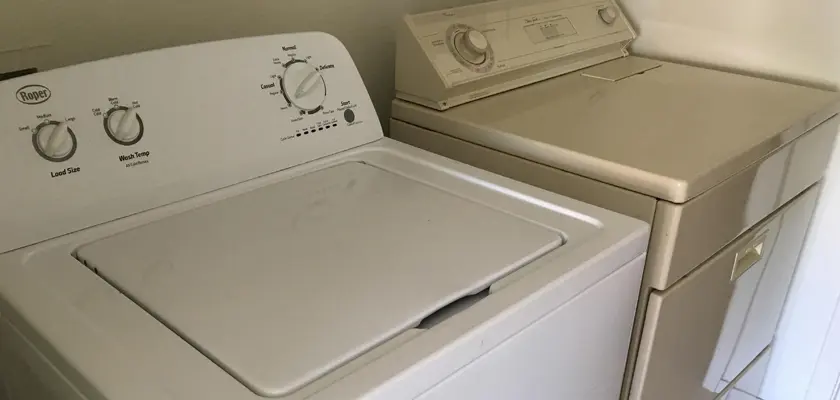
Depending on the size of your family, you may use your washer and dryer anywhere from a few times a week to multiple times a day. So when your washer and dryer aren’t working, it can be a real problem.
Look for these four signs when your washer and dryer should be replaced and get them taken care of before you have to waste any of your time or money at the coin-op laundromat.
The question most homeowners face isn’t whether their machines will eventually need replacing, but when. Waiting too long means one appliance failure turns into two, and an urgent replacement often costs more than a planned one.
Spotting these issues early can save you from repeated repairs, rising costs, and unexpected disruptions.
Check your washer and the area around it for leaks and puddles. Sometimes, leaks are caused by a loose connection or a damaged hose that can often be repaired or replaced. Other times, especially with older machines, leaks are a sign of worse things to come.
We have seen situations where homeowners replaced hoses and clamps multiple times, only to later discover internal tub damage or bearing wear. By that stage, repair costs had already crossed what a replacement would have cost earlier.
What this usually means:
Pro tip: If your washer keeps leaking despite fixes, it’s often a sign you’re nearing the end of its usable life.
Whether it’s banging, clanking, rattling, or any other unusual sounds, when your washer or dryer is doing its best impression of a rocket about to launch, it’s likely in urgent need of repair or replacement.
Of course, this isn’t always the case. Your washing machine may simply be off-balance. Before you start shopping for a new one, try washing smaller loads and making sure the distribution is even before you start it, especially when cleaning heavier items like towels and comforters. If this doesn’t fix the issue, stop using it and call in a pro to investigate.
Oftentimes, a dryer that isn’t drying clothes may just be blocked up. Make sure all lint screens are cleared and that the vent isn’t clogged (you can find the vent outside your home). You should be able to feel a strong airflow coming through the vent while the dryer’s running.
Make sure there aren’t any bends or kinks in the air duct behind the dryer that could be preventing air from escaping. In some cases, issues like a dryer timer not working can also affect drying performance by interrupting cycles before clothes are fully dry. Finally, if that doesn’t solve the issue, try disconnecting the dryer and checking for any blockages that way. If that still doesn’t remedy the problem, your dryer may be done.

No matter how great your washer or dryer may be, all things must come to an end. The typical lifespan of a washing machine is about eight years, though they have been known to last longer. That said, if your washer and dryer have been around for nearly a decade, chances are you’ll be looking to replace them soon enough.
That said, once your appliances are nearing a decade old, repairs tend to become more frequent and less predictable. If replacing them immediately isn’t financially practical, having coverage from the best home warranty company can help. It can manage repair costs for older machines and keep them running longer while you plan for an upgrade.
Most washers last around 10–12 years, while dryers typically last 12–15 years with proper care. Here is the average lifespan of its different types:
Several factors can shorten or extend the life expectancy of washer and dryer units:
A washer and dryer used daily in a large household will naturally wear out faster than machines used only a few times a week.
In older New England homes, especially throughout Worcester where laundry appliances often run heavily during colder months, aging washers and dryers can become more prone to leaks, motor failures, and drainage issues. Many homeowners look into a home warranty provider in Worcester to help manage unexpected appliance repair costs before a complete breakdown interrupts daily routines.
If your washer or dryer is approaching or past the 10-year mark, the signs below carry extra weight. An older machine with recurring issues is rarely worth repeated repair costs, especially when parts availability starts to shrink.
Most washers are built to last around 10–12 years, and most dryers a little longer. But age is only one part of the picture. Leaks, unusual noises, drying failures, and escalating repair costs are all signals worth taking seriously, and the older your machines are, the more weight each one carries.
When you do reach the point of replacement, a home warranty can help manage the cost of unexpected appliance failures in the meantime. Select Home Warranty covers washers and dryers under home warranty plans, which means repair and service costs go through us instead of coming out of pocket. To learn more about what’s covered, reach out to us at 800-670-8931.
This is often caused by restricted airflow, clogged vents, or declining heating efficiency, common in older dryers nearing the end of their lifespan.
Most home warranty plans cover repairs due to normal wear and tear. Replacement may be offered if the unit cannot be repaired, depending on your plan terms.
The drum, tub bearing, or transmission are usually the most expensive washing machine repairs because they involve both costly parts and heavy labor. In many older machines, these repairs can cost almost as much as buying a new washer.
Repairing is cheaper for small issues like hoses, pumps, or clogged drains. But if the washer is over 8–10 years old or the repair cost is very high, replacing it is usually the smarter long-term choice.

Don’t wait until it’s too late! Check out our current plans and get your free quote.
Household Tips
A broken appliance doesn’t always mean a trip to the store for a new one. In many cases, all you need is the right appliance replacement parts to get it..

Household Tips
If you’re reading this, odds are summer’s just around the corner or already here. Before you kick back to enjoy the sunny days to come, DIY home inspections and maintenance..

Household Tips
Everyone has their happy place. For some, that place is relaxing on the couch, while for others it’s relaxing in the hot tub. Your jetted tub or spa requires routine..